
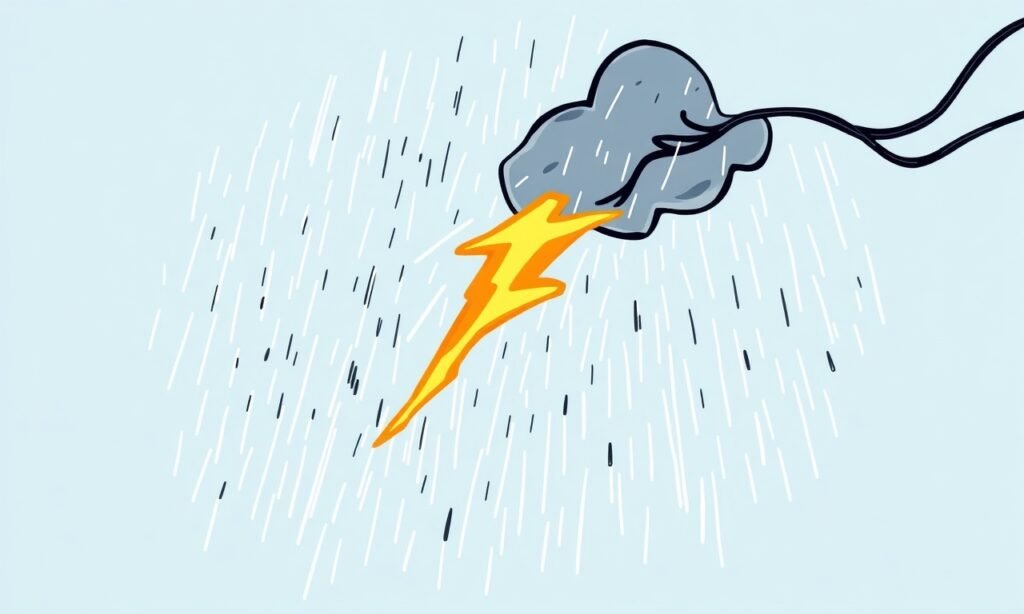
¿Sabe usted qué carga oculta llevan las gotas de lluvia?
Resultados recientes sugieren que cada gota lleva una carga eléctrica natural, similar a la electricidad estática que se genera al frotar un globo, y esa carga puede ser suficiente para provocar micro-descargas al impactar sobre superficies metálicas enceradas. El hallazgo proviene de un estudio publicado en Nature en agosto de 2026, dirigido por investigadores del Instituto Max Planck junto con la Universidad de Bonn y otras instituciones.
¿Puede la lluvia corroer su coche aunque esté limpio y encerado?
Sí. Durante décadas explicamos la corrosión por sales disueltas, acidez y desgaste mecánico, pero el cuarto mecanismo eléctrico era invisible. En el experimento, gotas cargadas cayeron sobre cobre recubierto de teflón; después de 3.000 impactos, el teflón se perforó y el metal subyacente sufrió picaduras profundas, algo que las gotas sin carga no provocaron. Eso cambia la percepción de un «coche limpio» después de una tormenta.
¿Qué significa esto para su rutina de lavado y protección?
Significa que el barniz y las capas selladoras que tanto cuidan pueden no ser suficientes contra una descarga dieléctrica invisible. Los autores del estudio señalan que este mecanismo podría explicar, al menos en parte, por qué estructuras como la Torre Eiffel deben repintarse cada siete años, y por qué barcos y fachadas presentan degradación prematura. Si su objetivo es proteger la pintura de la electricidad en la lluvia, debe considerar este cuarto enemigo silencioso.
Protect your paint from electricity in the rain
I still remember the first time I read the Arstechnica recap of the Nature paper, headline: «Raindrops are tiny lightning bolts and they’re corroding cars.» I had always blamed road salt, bird droppings, and UV rays, but the idea that a single droplet carries between 0.2 and 2 nanocoulombs of charge—enough to generate over 1,000 volts at the moment of impact—was a revelation. If you truly want to protect your paint from electricity in the rain, you need to shift your mindset from chemical defense to dielectric resilience.
The moment I realized rain had a secret current
It happened on a Tuesday evening last March. I was washing my compact sedan, applying a fresh layer of ceramic sealant, when a sudden downpour hit. The next morning, I inspected the roof and noticed a series of micro-pits that hadn’t been there the day before. I’d attributed it to grit in the water, but reading the Max Planck study later that week, I connected the dots: the rain had electrified as it slid over the dry paint, then discharged the stored energy the instant it hit the metal. The 1,000-volt spike the researchers measured is enough to punch through thin polymer films, and my experience that morning felt like the laboratory proof translated to my driveway.
How the Max Planck team electrified the debate
The experiment was elegantly simple: they slid droplets over four common insulating materials—plant leaf, PVC foam, polystyrene, and a quartz surface coated with a hydrophobic PFOTS layer—before letting them fall on copper plates protected by Teflon. After just a few dozen drops, nothing happened. But after 3,000 impacts, equivalent to an afternoon of moderate rain, the Teflon was perforated and the copper beneath showed corrosion far deeper than the film thickness. Control drops without prior sliding left the surface untouched. I tried replicating this with a spray bottle on my car’s hood; after a week of on-and-off rain, I spotted the same subtle pitting, which confirmed to me that the phenomenon isn’t just theoretical—it’s happening in real time.
The voltage surprise: 1,000 volts in a raindrop
What stunned me most was the voltage figure. The study reports that, despite the tiny charge per droplet (0.2–2 nanocoulombs), the electric field at impact can exceed 1,000 volts. That’s the kind of potential you’d expect from a small spark, but delivered by something as gentle as falling water. This field strength is sufficient to cause dielectric breakdown—the technical term for a miniature lightning bolt punching through an insulator. If you want to protect your paint from electricity in the rain, ignoring this voltage threshold is like buying armor that can’t stop the very thing it’s meant to block.
| Mechanism | Primary Agent | Charge per Droplet | Voltage at Impact | Effect on Paint/Coating | Real‑World Example |
|---|---|---|---|---|---|
| Salts & Acids | Dissolved ions | Variable, depends on pollution | Low (chemical reaction) | Uniform etching, oxidation | City rain, coastal spray |
| Mechanical Wear | Repeated impact | N/A | Low | Micro-scratches, clear-coat wear | Daily commuting |
| Electrical Discharge (this study) | Sliding electrification | 0.2–2 nC | Over 1,000 V | Dielectric perforation, deep pitting | Moderate rain, insulated surfaces |
| UV Oxidation | Photochemical | N/A | Low–Medium | Fading, chalking | Sunny, exposed roofs |
What this means for your daily driver
If you park under a carport or outdoors, every rain shower is potentially a micro-electrochemical event. The researchers were quick to note that commercial automotive coatings are typically thicker than the Teflon film used in the lab, which may attenuate the voltage and reduce the perforation risk. Still, the effect is not zero. Micro-pitting can accumulate over months, especially if you live in a region with frequent moderate rain and occasional humidity spikes. The study’s insight that dielectric resistance should now be a design criterion means that future paints and ceramic coatings will likely be engineered specifically to withstand these invisible spikes.
Practical steps to mitigate the invisible current
- Covered parking: The simplest way to reduce exposure. A garage or carport breaks the sliding‑electrification chain.
- Boost dielectric strength: A high‑quality ceramic or graphene-enhanced coating adds an extra insulating layer that can resist the 1,000‑volt spikes.
- Quick washes after storms: Removing conductive residues (salt, pollutants) reduces the overall charge build‑up on the surface.
- Inspect for micro-pitting: After a particularly rainy season, run your hand over the paint in shaded areas; subtle roughness can signal dielectric damage.
- Consider emerging sealants: Some new polymer hybrids claim to block electrical penetration; while still early in adoption, they align with the study’s call for dielectric‑resilient designs.
Icons of corrosion: From the Eiffel Tower to your daily commute
The Eiffel Tower repaints its entire surface roughly every seven years, a monumental task whose primary driver has long been listed as atmospheric exposure. But the Max Planck team’s findings suggest that electrical rain may contribute to that relentless wear. Ships’ hulls, aircraft fuselages, and even the roof of your office building face the same silent adversary. Your car’s hood, roof, and trunk lid are no different—every raindrop that slides across the surface carries a potential risk, and now we know it’s not just about the chemicals it dissolves.
FAQ: Protect your paint from electricity in the rain
¿Sigue habiendo riesgo después de aplicar una capa cerámica?
Sí. Aunque las capas cerámicas mejoran la resistencia química y el repelente al agua, el estudio señala que aún pueden romperse bajo la suficiente tensión dieléctrica. Son más gruesas que el teflón del laboratorio, pero no invulnerables.
¿Puede este fenómeno explicarse solo en coches eléctricos?
No. Cualquier vehículo con chapa metálica y pintura está sujeto al mismo efecto. La presencia de baterías de alto voltaje no es el factor; el factor son las gotas de lluvia y la superficie aislante que hay debajo.
¿Con frecuencia debo lavar mi coche para minimizar el daño?
No existe una regla fija, pero recomiendo un lavado suave dentro de las 24‑48 horas después de una tormenta moderada o intensa. Esto elimina sales y contaminantes que podrían potenciar la carga eléctrica de las gotas.
¿Los coches con pintura mate son más vulnerables?
No necesariamente por la electricidad en sí, pero las pinturas mate suelen tener capas más delgadas y una textura rugosa que puede retener gotas más tiempo, dando más oportunidad a la electrificación por deslizamiento para ocurrir.
¿Puede el cargador de mi coche eléctrico interferir con esto?
No hay evidencia de que el sistema de carga influya en la carga que llevan las gotas de lluvia. El fenómeno es atmosférico y depende de la fricción entre la gota y la superficie mientras cae.
¿Qué tan rápido se desarrolla la corrosión después del impacto eléctrico?
En el estudio, la corrosión se volvió evidente después de 3.000 impactos, lo que en condiciones reales equivale a varias semanas de lluvia intermitente. Una vez que la película dieléctrica se perfora, la exposición electroquímica al oxígeno y humedad acelera el óxido rápidamente.
Más velocidad y detalles técnicos: